

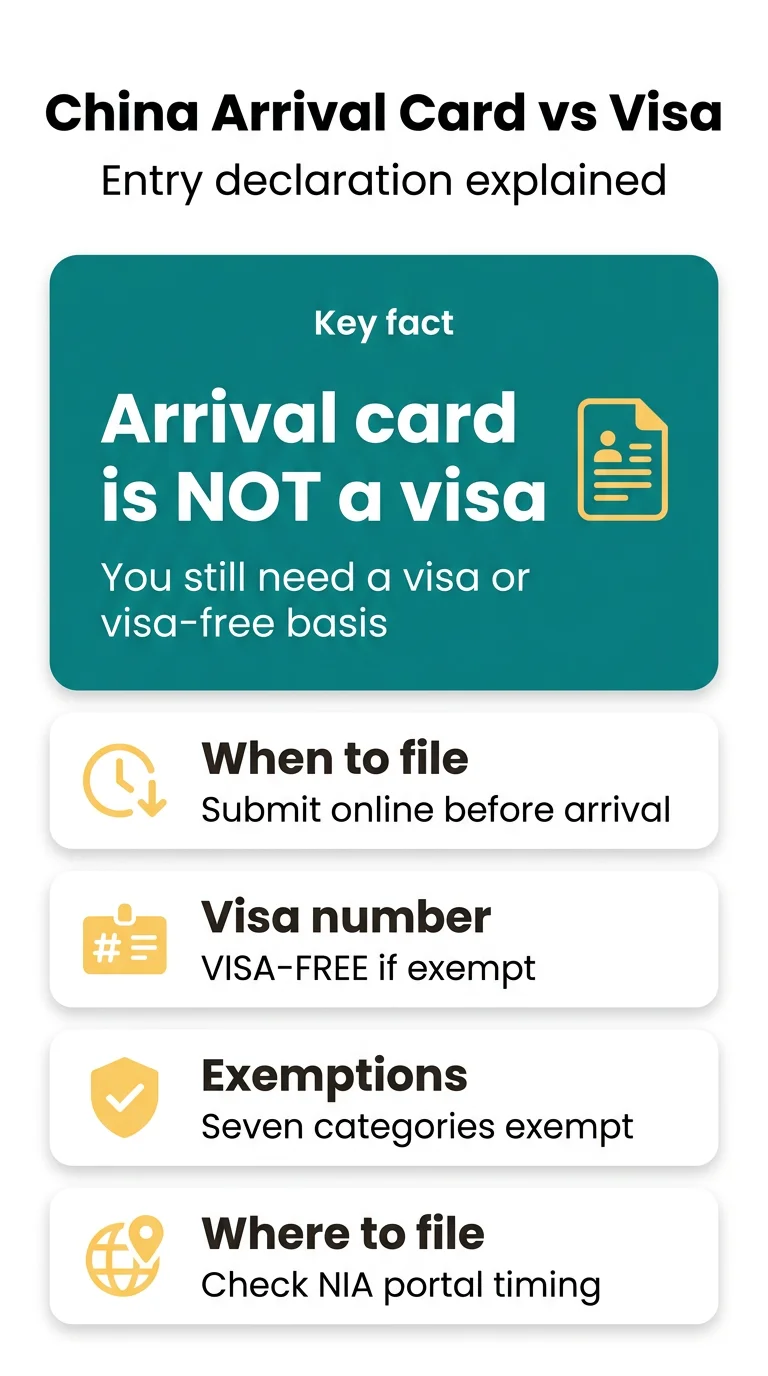
Is China arrival card the same as a visa? No. The arrival card is a border entry declaration, and it doesn’t give you permission to enter. You still need a consular visa or a valid visa-free basis to pass border control. See the 30 day visa-free China arrival card rules if you enter without a visa.
This is an independent guide, not a government site. Check the Australian embassy notice on online filing and the National Immigration Administration (NIA) portal, before you fly. Here’s who still files and how to fill it in.
Is China Arrival Card the Same as a Visa?
The Arrival Card for Foreigners is run by the NIA. It records your identity, your address in China and your purpose of visit. A visa is different: an embassy or consulate issues it abroad, before you travel. If you’re filing for the first time, the step-by-step online guide walks you through the whole process.
| Document | Issued by and when | Grants entry? |
|---|---|---|
| Arrival card | NIA; filed online before arrival, or on paper at the port | No |
| Consular visa (L, M) | Embassy or consulate, before travel | Yes, subject to border inspection |
| 240-hour visa-free transit (up to 10 days, designated regions) | No visa issued | Yes, limited to time and designated regions |
One caveat: a completed card doesn’t rescue you without a visa or exemption, and entry can still be refused. A visa doesn’t replace the card either.
The Australian embassy published an implementation notice on the online arrival card on 28 Nov 2025.
Arrival Card vs Visa for Visa-Free Travellers
Visa exemption removes the visa, not the declaration, so you still file the card when you enter visa-free. Visa-free entry depends on your nationality and current terms; check the Chinese embassy or the NIA portal.
Seven categories of travellers are exempt from the card:
- Foreign Permanent Resident ID Card holders
- Non-Chinese holders of the Mainland Travel Permit for HK/Macao
- Group visa or group visa-free holders
- Direct transit passengers who stay airside for up to 24 hours
- Cruise passengers entering and leaving on the same vessel
- Fast-track or E-channel users
- Foreign crew of exit-entry transport vehicles
A solo tourist entering visa-free isn’t on this list. Flying from Changi? Exit clearance and the SG Arrival Card (SG Arrival Card), which covers only entry into Singapore, don’t replace China’s declaration — the China arrival card vs SG arrival card differences explain how the two forms compare.
What to Write in the Visa Number Field
In the visa number field, enter your visa number. If you don’t have a visa, type “VISA-FREE” in capitals. Don’t leave it blank.
Enter your personal details
Type your name as in your passport, birth date (YYYY-MM-DD), gender, nationality and passport number.
Add your travel details
Add your flight, train or vessel number, arrival date, address in China and purpose of visit.
Fill the visa number field
Fill the visa number field as in the table below.
Add contact and sign
Add a contact phone number, and sign as in your passport if you use the paper card.
| Traveller | Enter |
|---|---|
| Valid L visa | The visa number in the red print at the top right of the visa page |
| Visa-free passport holder | “VISA-FREE” |
Check that your passport is valid for your whole stay.
When and Where to File, and Corrections
File online before you land, then show the QR code and your passport at the border checkpoint. Pick one NIA channel:

- The NIA website, on a PC or phone
- The NIA Government Service Platform website
- The “NIA 12367” app
- The WeChat mini program
- The Alipay mini program
Submit the card online before you fly. No official filing window was found, so check the timing on the NIA portal — our guide to submission timing and QR code validity covers what’s known so far.
Spotted a typo after filing? The sources reviewed don’t describe how to correct a submitted card. Check the NIA portal for any edit option, and use a paper card at the port if the portal offers none. Reports say China may impose entry bans of up to five years for false statements in border procedures. For fixing errors in general, see our article on arrival card mistakes and corrections.
Common Mistakes
- Treating the card as a visa. Confirm your visa or visa-free basis before you fly.
- Leaving the visa number field blank. Use your visa number or “VISA-FREE”.
- Paying a middleman. Some third-party sites charge for the form; use one of the NIA channels listed above.

Frequently Asked Questions (FAQ)
Is China arrival card the same as a visa?
No. The arrival card is an entry declaration filed for border inspection. A visa is consular permission issued before you travel. The card grants no right to enter, so you still need a valid visa or a visa-free basis.
Is China arrival card the same as a visa for Singapore passport holders?
Still no. When you enter China visa-free you don’t need a visa, but you do file the card and write “VISA-FREE” in the visa number field. Visa-free entry rules depend on your nationality and the current terms; check with the Chinese embassy or the NIA portal before you travel.
How much does the arrival card cost compared with a visa?
The sources reviewed don’t state a fee for the arrival card. For visa fees, check the Chinese embassy in your country before you apply.
What do I write in the Visa No. field?
Type “VISA-FREE” in capital letters if you’re visa-exempt, or enter your visa number if you hold one.
Can I board a flight to China with only the arrival card?
Not on its own. The card does not replace your passport or your visa or visa-free basis. Check these before you travel.
When should I submit the China arrival card?
There is no official filing window. Check the NIA portal for the current timing, and keep the QR code ready on your phone.
Can I edit the arrival card after getting the QR code?
The sources reviewed don’t describe how to change a card after submission. Check the NIA portal, and use a paper card at the port if needed.
Where can I file the China arrival card online?
Use the NIA channels listed above: the website, the “NIA 12367” app, or the WeChat and Alipay mini programs. The Australian embassy’s notice describes online filing. Paper forms are the fallback.
Sources and Further Reading
- Chinese Embassy in the Philippines: homepage
- Chinese Embassy in Australia: online filing implementation notice
- Singapore MFA: homepage
Rules can change, so check the portal before you travel.